
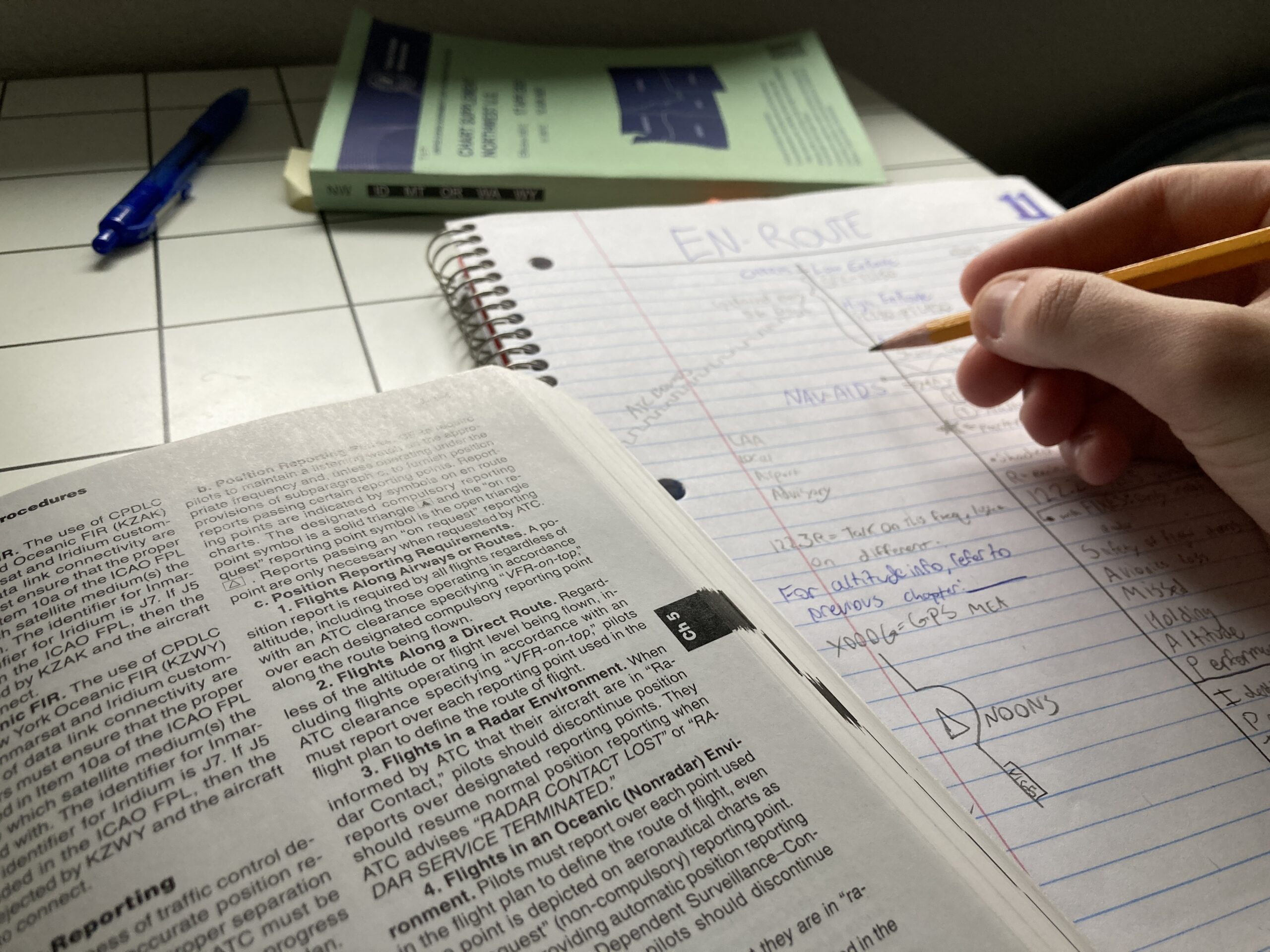
Don’t be intimidated by textbooks! In this article, I’ll share with you how you can study effectively in an actionable and measurable way! This is intended for students seeking to improve their study discipline. The analogies will be made to private pilot textbooks, but for the IR student or COM student, the philosophy remains the same.
We already have an advantage: we know what the content of each book is. PHAK is for theory, AFH is for in-flight maneuvers. POH is for your airplanes’ specs. The FARs are your rules, and the ACS is what the test will be like.
*for IR training, you’ve got the IPH, IFH and most assuredly the FAR/AIM! *
I recommend 4 steps to successful studying:
1. Take Inventory
2. Write Down Your Goal
3. Perform & Measure
4. Ask Questions
Step 1.) Take Inventory
Identify your resources. This prevents aimless studying and will keep you focused. So, ask yourself: What sources can you study from?
With the different information sources in mind, you will be able to search efficiently for the answers you need.
To demonstrate, I have listed some private pilot resources:
(If you’re working on IR or COM look >HERE< for resource breakdown)
“PHAK”
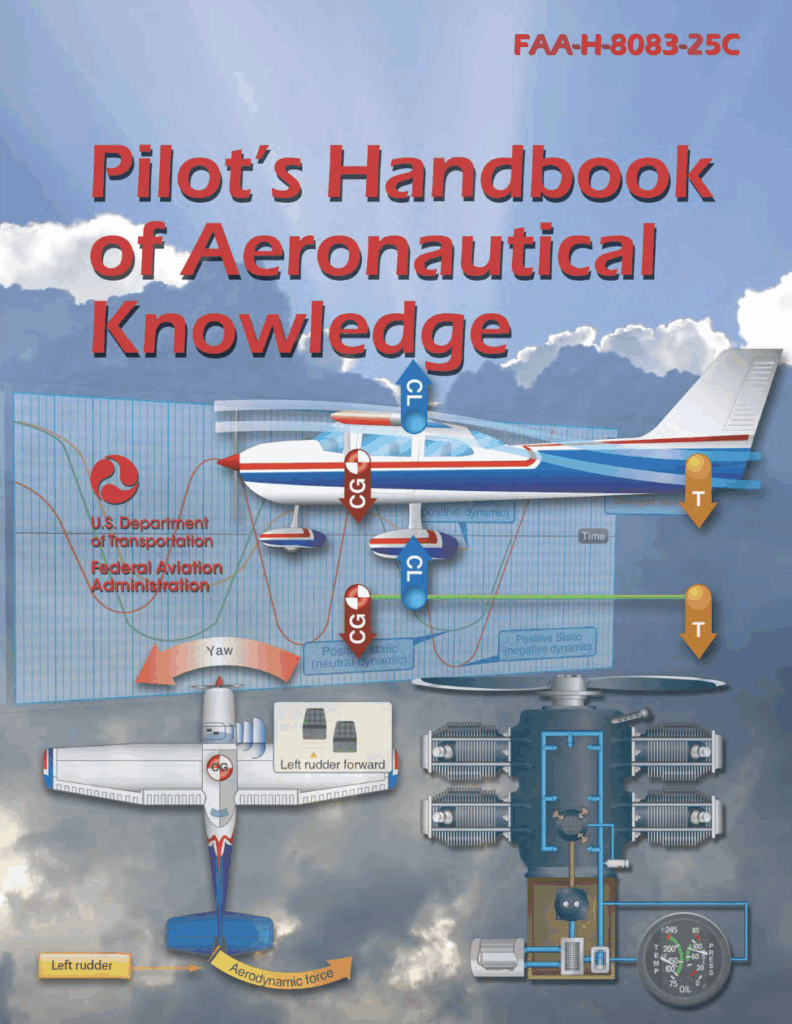
This is all about the theory you’ll need to know.
1.) Intro
2.) ADM
3.) Aircraft
4.) Principles
5.) Aerodynamic
6.) Controls
7.) Systems
8.) Instruments
9.) Documents
10.) W & B
11.) Performance
12.) Wx
13.) Wx Services
14.) Airports
15.) Airspace
16.) Navigation
17.) Medical Facts
“AFH”
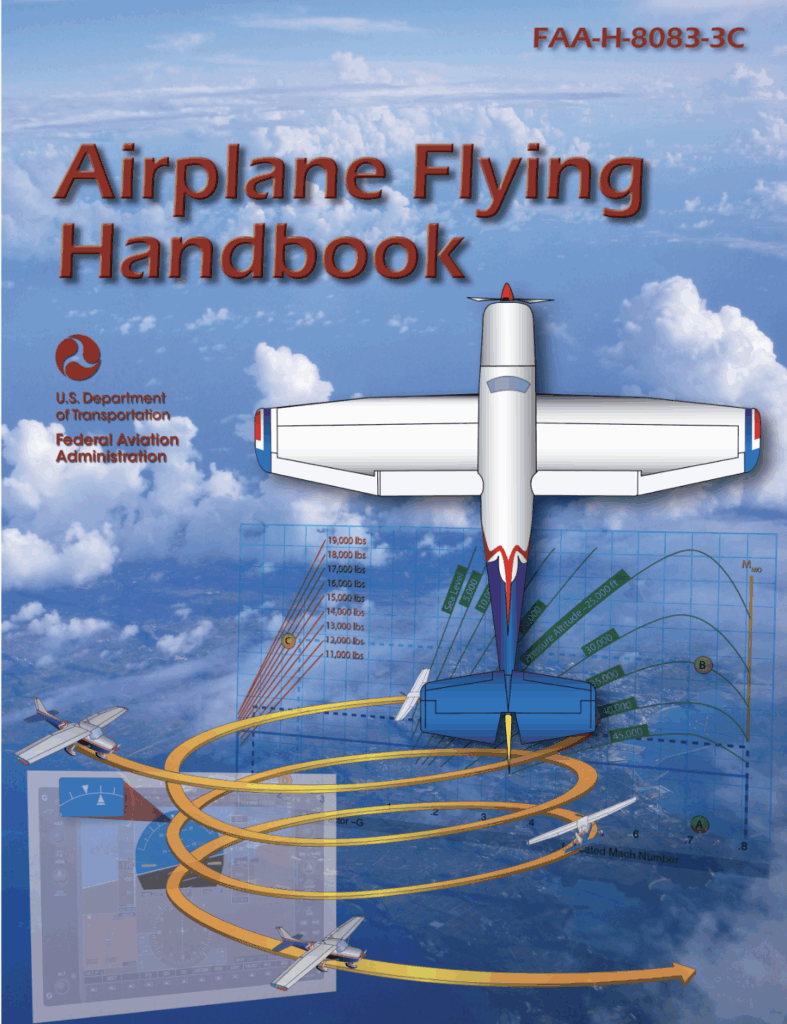
This explains flight maneuvers while flying.
1.) Intro
2.) Ground Ops
3.) Basic Flight
4.) Energy control
5.) Losing control
6.) Takeoff
7.) Ground Ref. Maneuvers
8.) Airports
9.) Landing
10.) Hi-perf. Man.
11.) Night flying1
2.) Complex syst.
13.) Multi-addon
14.) Tailwheel
15.) Turbo-Props
16.) Turbo-Jets
17.) LSA Planes
18.) Emergencies
“POH”
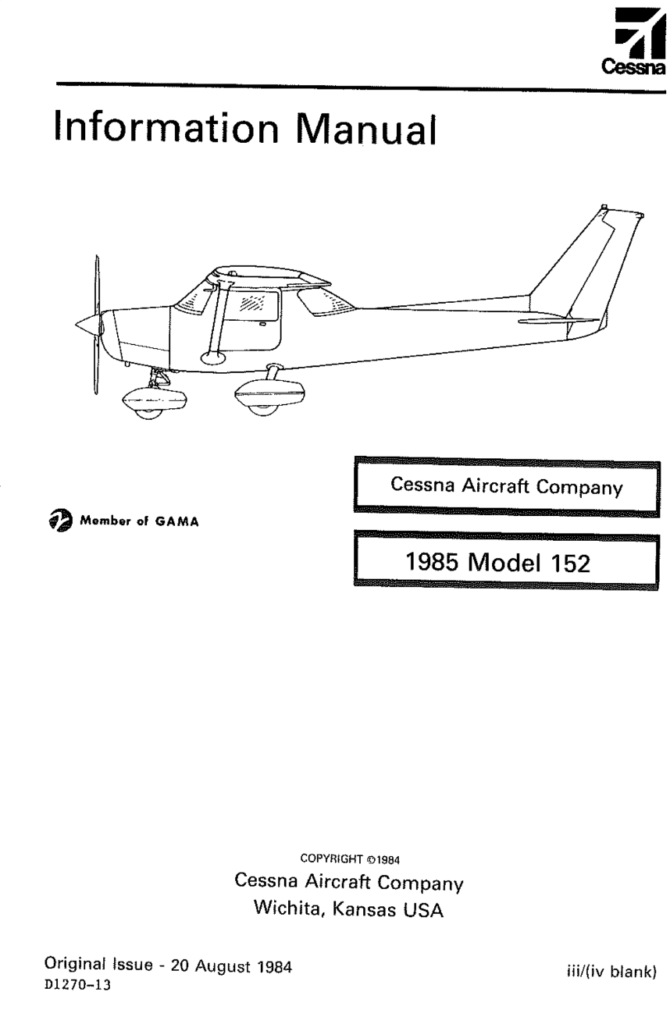
This is all about YOUR airplane.
1.) General
2.) Limitations
3.) Emergency
4.) Normal
5.) Performance
6.) W&B
7.) Systems
8.) MTX
9.) Supplements
“FAR/AIM”
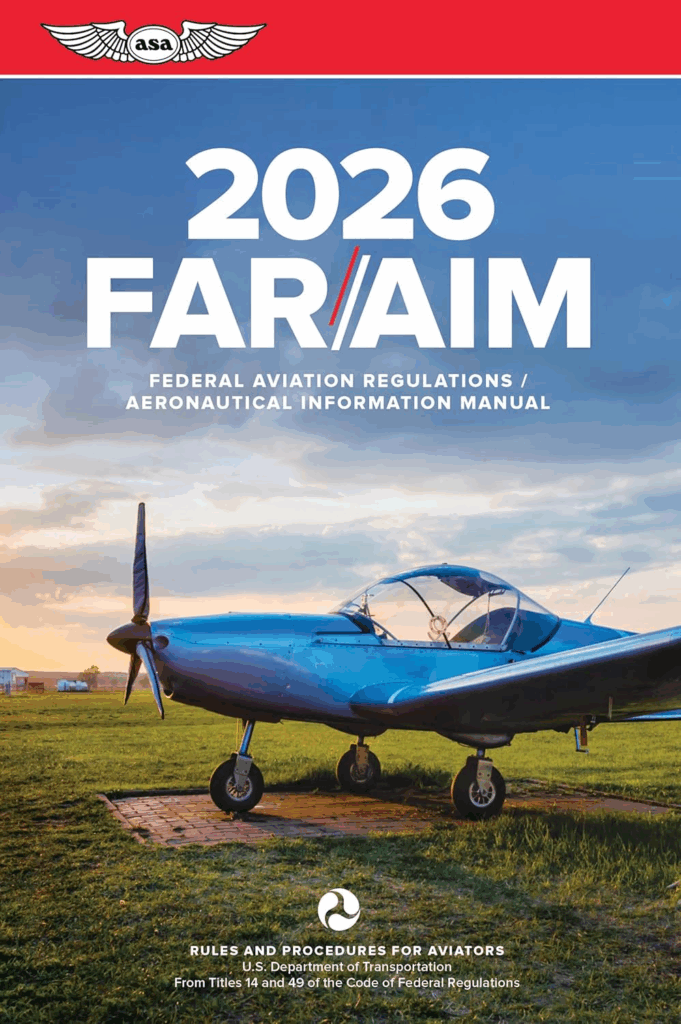
These are the rules you’ve got to obey when you fly!
Pt. 1- Definitions
Pt. 43- MTX
Pt. 61- Training
Pt. 91- Flght rules
Pt. 141- big schools
“PVT ACS”
This book lists the exact subjects you’ll be examined on!
I. Preflight prep
II. Preflight procedure
III. Airport Ops.
IV. Takeoff & Landing
V. Maneuvers
VI. Navigation
VII. Slow Flight & Stalls
VIII. Instrument Flying
IX. Emergency Ops.
X. Multi Ops.
XI. Night Flying
XII. Postflight
Yes, all together, those books have a bit over 2,000 pages total.
Really not so bad when you consider The Count of Monte Cristo by Alexandre Dumas has ~1,200 pages!
Do not despair! With a bit of philosophy, you can persevere and read through them all like it’s nothing! The key is: BREAK THEM DOWN BY SUBJECT (I have written brief descriptions above to help)! Some subjects don’t concern you, ex. you will come across “Turbo Jet Powerplant” section in the PHAK, of course, if you’re training in a Cessna 152 (not a turbo-jet airplane) you should skip this section to focus on piston engines (Cessna 152 has a piston engine)!
As you move to step 2, also break the books down into chapters. Each chapter will help you tackle each subject one chapter at a time. As they say, Rome wasn’t built in a day, but a brick was laid every hour!
Also, on a given day, you may ask yourself when you wake up but what page should I open to? Answer this question by searching the table of contents for the subject area you know the least about! The ACS is an evaluation tool. I have dimmed it’s background slightly to signify that is should only be lightly used. The ACS is the place to go when you think you’re ready-to-go, but want to check yourself against something.
Step 2.) Write Down your Goal
S.M.A.R.T.E.R. goals are the best. They are taught in schools for a good reason. Write your goal(s) in your notebook (do organize notes into a notebook)!
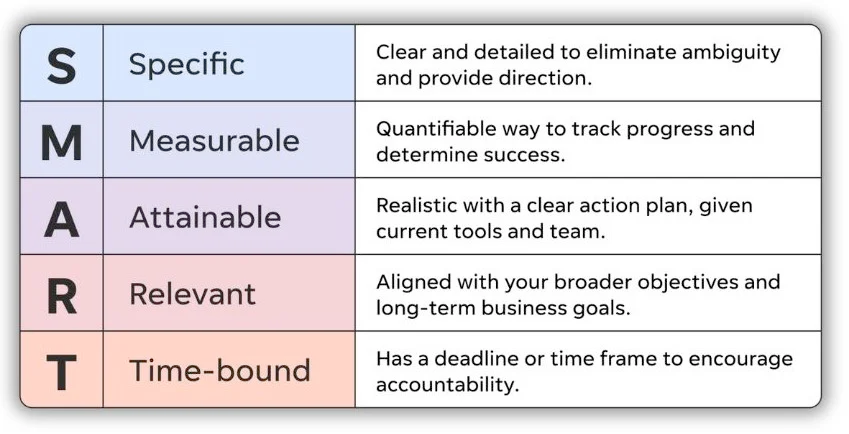
Ex. When I studied for private pilot training part time, my goal was
“I will study for 2 hours every day, and verbally summarize my learnings at the end of the study session”
When I studied for my instrument rating full time, my goal intensified:
“I will study 4 hours total every day and complete minimum 1 textbook chapter every day & quiz myself at the end of the day with the flashcards I made”
When studying for commercial & CFI certificates full time, my goal was:
“I will study every chance I can. I will alternate between studying for 2 hours, then a 20 minute break, then back”
Play around with your studying block time. This author likes to study for 2 hours at a time. Others prefer longer or shorter. 50 minute study blocks are a good starting point. Committing to such an intense goal will require sacrificing leisure time. I had to sacrifice video games. The decision was clear though, full time flying > Xbox.
Step 3.) Perform & Measure
Set yourself a reminder for first thing in the morning after breakfast.
Set timers while you study to measure your progress.
Avoid distractions. Delete social media / games if it distracts you.
As you complete pages / chapters, physically cross them off your list (you may use a pencil on a sticky note, or just digitally annotate the table of contents)!
There are many different ways to study. Here are some ideas:
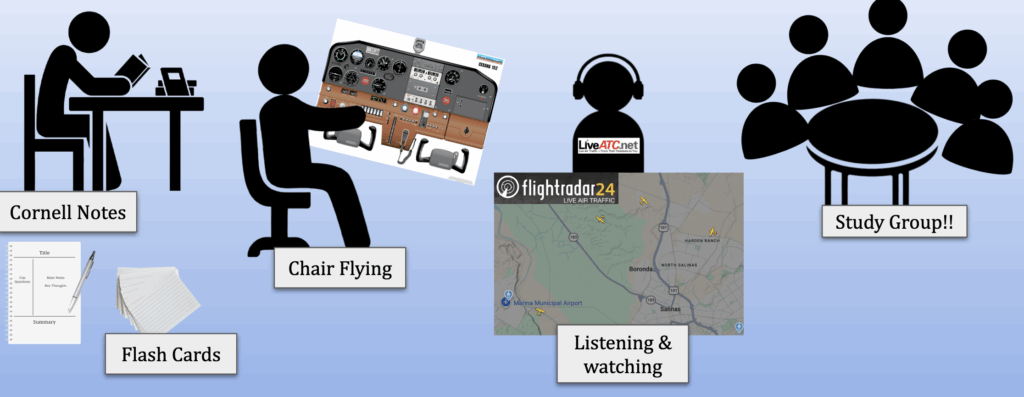
Chairfly, Fly your home simulator, make flash cards, quiz your friend & be quizzed by your friend, listen to aircraft accident case studies.
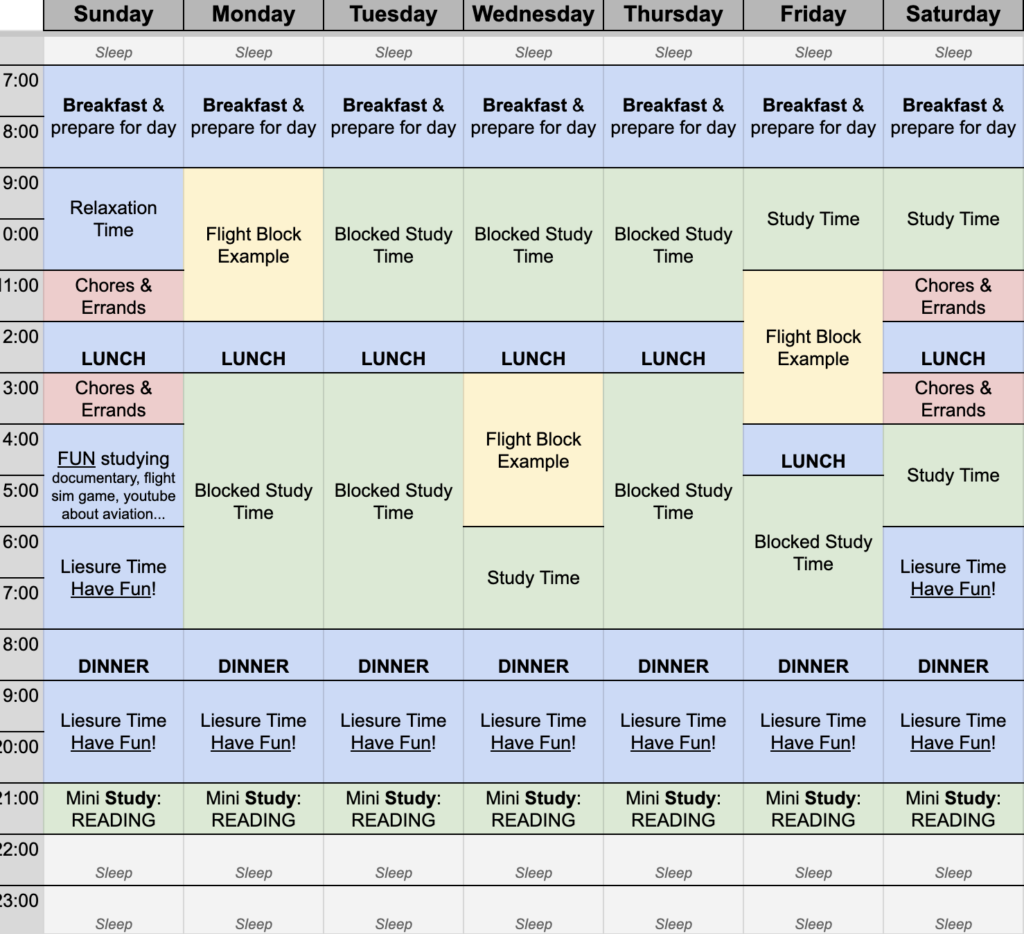
Setting a schedule and timer as you study can really help (Just like setting a time-bound goal)! Also, waking up and sleeping at the same time will improve your circadian rhythm. Here is an example of a study routine. Please feel free to take it, adjust it as you see fit.
Step 4.) Ask Questions!
You’re not done yet!
Flight training can be tough. Study groups will hold you accountable to your study goals, introduce you to new study techniques, and peer-quizzing. Build a study group by networking with your ground-school-classmates. Hanging out at the airport is a great way to meet people aswell. A good way to spark up conversation is of course with questions!
Ask your study group, CFI, and ground instructor questions when you have them. Don’t fail silently. If you dont understand something, reach out:
“Hey, study group, does anybody understand _____? Where did you learn about it?”
“where can I learn more about ____?”
“I’m having trouble understanding _____, where can I look for more information?”
Resources (IR/COM)
At the higher levels of training (IR, COM, CFI) there are so many different textbooks, I cannot possibly list them all. Aviation Weather Handbook, Weight and balance handbook. . .etc. are accessible for free on the FAA website. Through this article, you should now be proficient to break those books down by chapter and subject, all on your own!
IR Resources
Note: I’ve INTENTIONALLY separated FAR and AIM. The AIM is very helpful for IR studying. It explains things concisely and exactly what you need to know, not too much information. IPH can sometimes go too deep in my opinion. I recommend starting with the AIM.
“IFH”
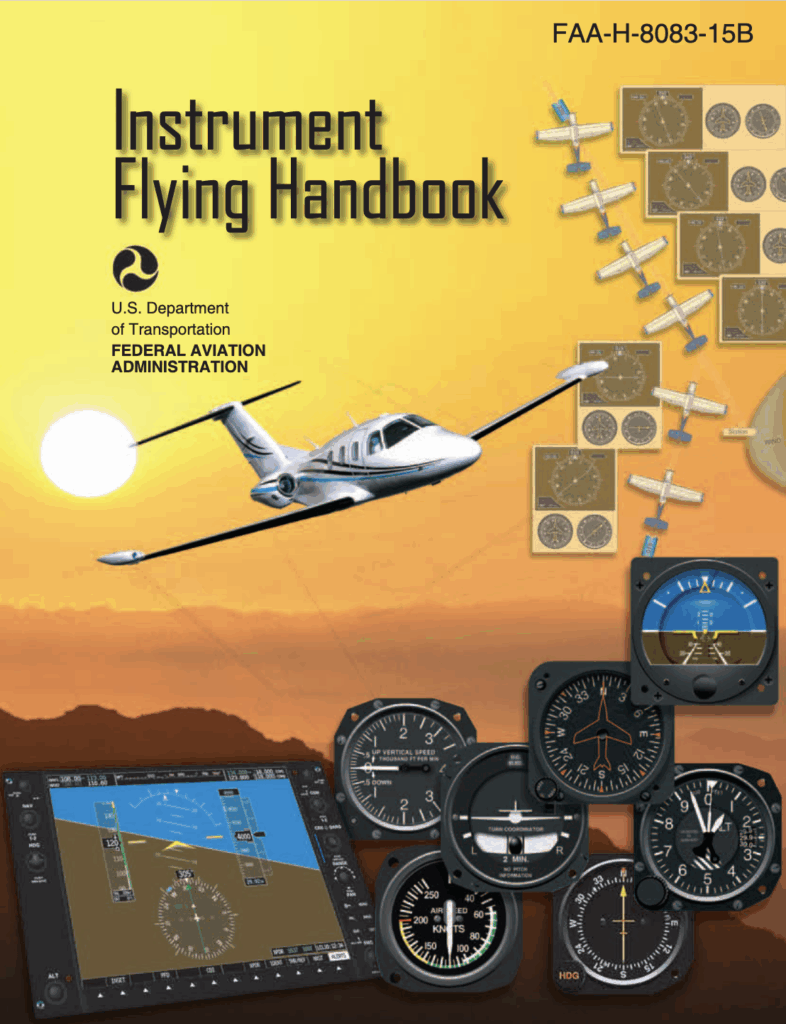
This is all about scanning and maneuvering in-the-airplane.
1.) Airspace
2.) ATC
3.) Medical Facts
4.) Aerodynamics
5.) Instruments
6.) Scanning
7.) Maneuvers
8.) Helicopters
9.) Navigation
10.) IFR flying
11.) Emergencies
“AIM”
Great concise explanations!
1.) Navigation
2.) Airports
3.) Airspace
4.) ATC
5.) ATC Proc’s
6.) Emergencies
7.) Safety
8.) Medical Facts
9.) Charts
10.) Helicopters
“IPH”
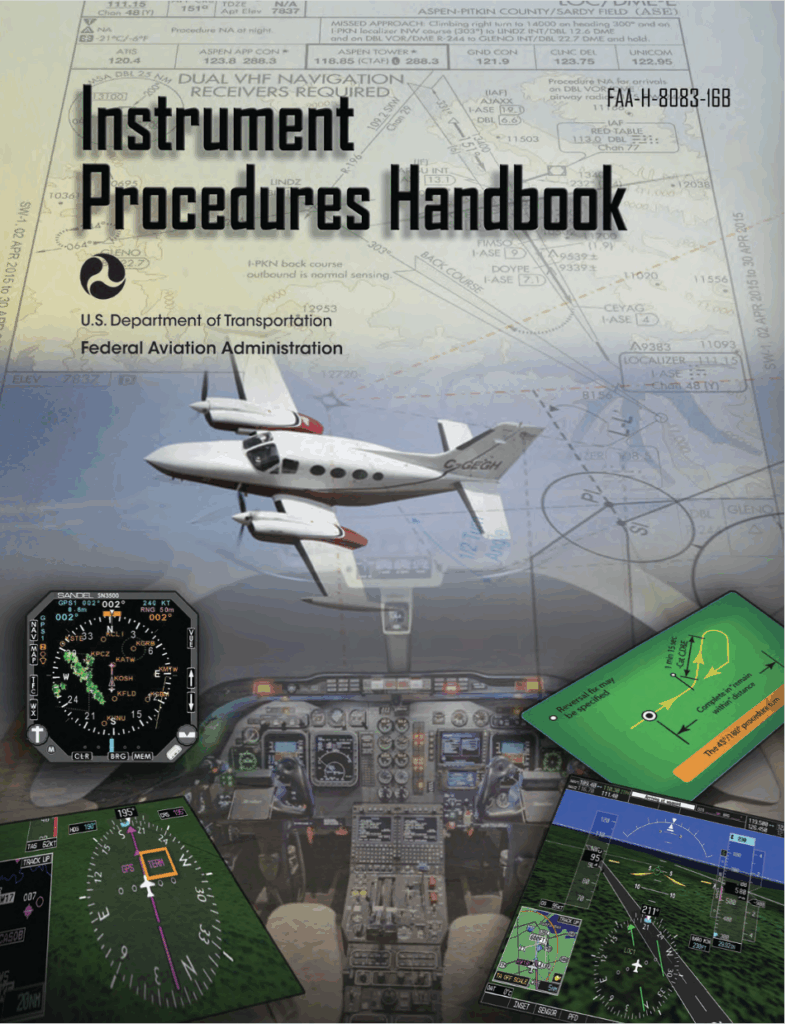
As the title suggests, this book focuses just on the procedures.
1.) Departures
2.) En-Route
3.) Arrivals
4.) Approaches
5.) The Future
6.) Navigation
7.) Helicopters
“FAR”
You must know all the VFR regs, now also the IFR ones!
Pt. 1- Definitions
Pt. 43- MTX
Pt. 61- Training
Pt. 91- Flght rules
Pt. 97- IFR Procs
Pt. 141- big schools
“IR ACS”
This book lists the exact subjects you’ll be examined on!
I. Preflight prep
II. Preflight procedure
III. Clearances
IV. Flying IFR
V. Navigation
VI. IAP’s
VII. Emergencies
VIII. Postflight
Multi-Engine Transition Resources
NOTE: some additional books can be purchased as well, ex. ASA Multi-engine pilot manual, and “concise guide to _____” book series is made for many different planes.
“PHAK”
Specifically:
Find chapters/subject that apply to the plane you’ll fly.
EX. if you’re going to fly a turbocharged DA42, read up about turbochargers in the PHAK systems chapter!
“AFH”
Specifically:
Chapter 13: “Transitioning to Multi-Engine Airplanes”
“POH”
Know your airplane! A multi will have many more complex systems. You’ll need to know them all like the back of your hand.
“ACS”
Since you’re doing an add-on checkride, you will only need to perform some of the ACS items. Search the back of the ACS for a list of the required tasks.
Commercial Resources
At the commercial level and onwards. Take a look at what you’ve already read and double down. If you haven’t read completely though the PHAK at this point, time to finish it. Apply the commercial pilot regulations to scenarios you make up!
Do not slow your studying! Some great books to enhance your airmanship:
Stick and Rudder – Wolfgang langewiesche
Mechanics of Flight – A.C. Kermode
Jet Law Explained – Kent S. Jackson
YOUR AIRPLANEs’ TCDS (find on FAA “DRS” website)
AC 120-12
AC 120-76
AC 91.21
AC 61-107